Trigger finger release is a small surgery that opens a tight tunnel at the base of a finger or thumb so the tendon can glide freely. It treats a finger that catches, locks, or snaps when you bend or straighten it. Most people go home the same day and use the hand soon after.
Lee Hunter performs trigger finger release in Columbia when it is the right step, and reviews every alternative with you first.
Who performs trigger finger release: a complete guide in Columbia?
Lee Hunter is a board certified orthopedic surgeon who performs trigger finger release: a complete guide in Columbia, TN. Dr. Hunter sees patients at the practice in Columbia; appointments can be requested through this site.
What do patients ask most?
Will the finger catch again after surgery?+
Do I really need surgery, or will an injection work?+
How soon can I use my hand?+
Will I need hand therapy?+
Can more than one finger be treated at once?+
Will there be a scar?+
Is the needle release as good as open surgery?+
What is Trigger Finger Release?
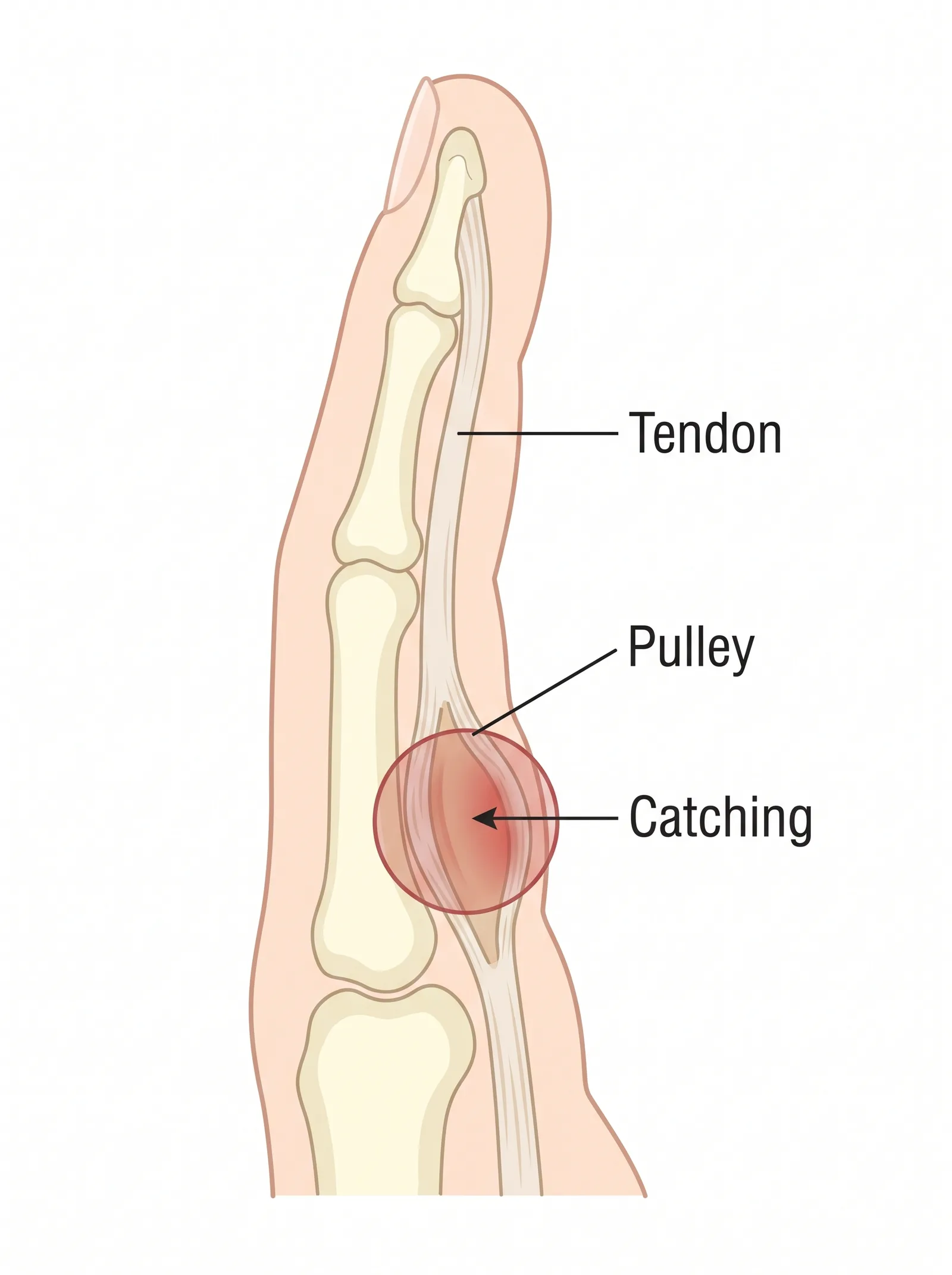
Trigger finger, known in medicine as stenosing tenosynovitis, happens when a tendon that bends a finger no longer slides smoothly through its tunnel.
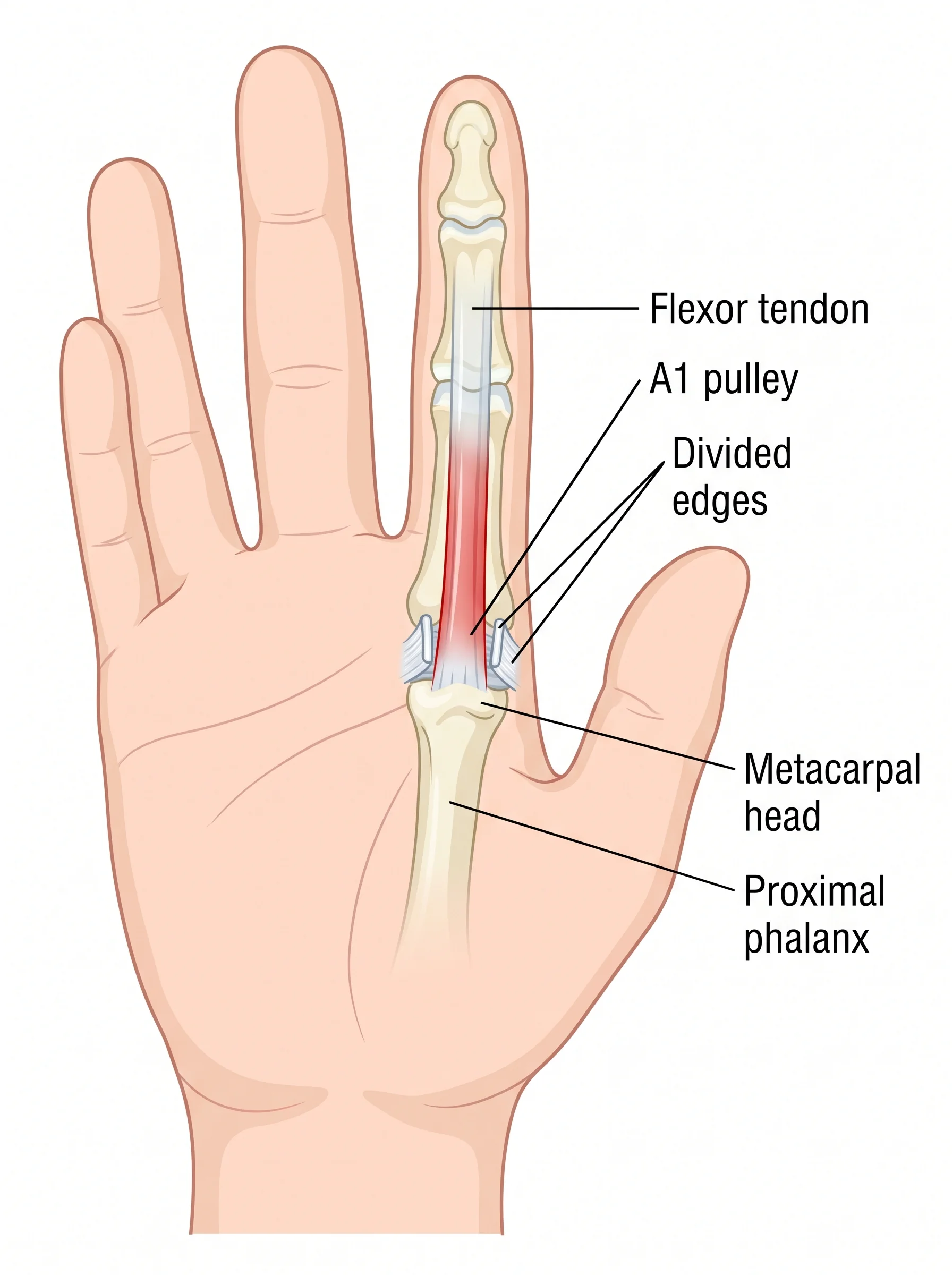
Tendons are the cords that connect muscle to bone; the ones that bend your fingers run along the palm side and pass through a series of snug loops called pulleys. The pulley at the base of the finger is called the A1 pulley.
When the tendon or its lining swells, or the pulley thickens, the tendon has trouble sliding through the A1 pulley. It can catch, so the finger clicks, snaps, or locks in a bent position. Sometimes the finger has to be gently straightened with the other hand. This catching is where the name "trigger finger" comes from.
Trigger finger release is the surgery that fixes this. The surgeon cuts the A1 pulley to open the tunnel. Once the pulley is divided, the tendon can glide freely again, and the catching stops. Cutting this one pulley does not weaken the finger, because the other pulleys still hold the tendon in place.
The condition is more common in people with diabetes, and it can affect any finger or the thumb. It can involve more than one finger. Surgery is usually short and done while you are awake, with only the hand numbed.
What are the symptoms of Trigger Finger Release, and when should you see a specialist?
Trigger finger usually builds up over weeks or months.
Patients often describe it like this.
- A clicking or snapping feeling when bending or straightening a finger. - A finger that catches partway, then pops through. - A finger that locks in a bent position and has to be straightened with the other hand. - A tender bump or lump in the palm at the base of the affected finger. - Stiffness and catching that are worse in the morning and ease as the hand warms up. - Soreness at the base of the finger on the palm side.
Symptoms range from a mild occasional click to a finger that locks and will not move on its own. Some people have discomfort but no true catching yet.
It is reasonable to see a hand specialist when a finger catches or locks regularly, when there is pain at the base of the finger that affects daily use, or when a finger is stuck and hard to straighten. If a finger locks in a bent position and you cannot straighten it, be seen promptly, because a finger left locked for a long time can become stiff. A specialist can confirm the diagnosis with a simple exam and talk through the range of treatments.
How is Trigger Finger Release diagnosed, and what does the visit involve?
Trigger finger is usually diagnosed from the story and the exam alone.
Special tests are rarely needed.
History. Dr. Hunter will ask which finger is involved, when the catching started, whether it locks, and whether it is worse at certain times of day. Because diabetes and some other conditions make trigger finger more likely and more likely to involve several fingers, those come up in the conversation.
Physical exam. The surgeon looks at how the finger moves and feels for a tender nodule at the base of the finger on the palm side. Often you can feel the tendon catch as the finger bends and straightens. The exam also checks the other fingers, since more than one can be involved, and confirms the finger can still straighten.
Imaging and tests. X-rays and nerve tests are usually not needed for trigger finger. They may be added only if the picture is unclear or if arthritis or another problem is also suspected.
The visit ends with a clear diagnosis and a discussion of options, starting with the least invasive.
What happens during Trigger Finger Release, step by step?
Trigger finger release is a short outpatient surgery, done the same day.
Here is the usual sequence.
Anesthesia. Most releases are done with local anesthesia, numbing only the hand or the base of the finger. You are usually awake. Light medicine to help you relax is available if needed.
Preparing the hand. The hand is cleaned and draped. A soft tourniquet may be used on the arm to limit bleeding for a clear view.
The incision. The surgeon makes a small cut, often less than half an inch, in the palm at the base of the affected finger, usually in a natural crease so the scar blends in.
Dividing the pulley. The surgeon finds the A1 pulley and carefully divides it. This opens the tunnel so the tendon can glide freely. The surgeon usually asks the finger to be moved, or moves it, to confirm the catching is gone and the tendon slides smoothly.
Checking and closing. After confirming free motion, the small incision is closed with stitches, and a light dressing is applied.
This is one of the quicker hand procedures. Because the catching is fixed mechanically, many people notice the finger no longer locks as soon as the numbness wears off, though soreness at the incision takes time to settle.
There is also an in-office option called a percutaneous release, where the pulley is divided with a needle rather than an open cut. Whether this fits you depends on the finger involved and your anatomy. Dr. Hunter will explain if it is an option for you.
What is the recovery timeline for Trigger Finger Release?
Recovery is measured by what the finger can do.
These ranges are typical, and they are ranges, not promises. General guidance from the American Academy of Orthopaedic Surgeons notes that finger motion usually returns quickly, while soreness in the palm takes longer to fully settle.
First days. You are encouraged to move the finger right away to keep it from getting stiff. Gentle bending and straightening several times a day is the goal. Keep the hand elevated to limit swelling. The catching is usually gone, though the area is sore.
Milestone: you can gently make a fist and open the hand, even if it is sore.
First one to two weeks. Stitches are often removed around this time. Light daily use of the hand is usually fine. The palm at the incision may feel tender, and pressing on it can be uncomfortable for several weeks.
Milestone: stitches out, incision healing, finger moving without catching.
Two to six weeks. Soreness fades and grip strength returns. Most people return to normal daily activities in this window. Desk workers often go back within days; people with heavy hand work may need a couple of weeks or more. Dr. Hunter will guide your timing.
Milestone: you can grip and use the hand for your usual tasks with only mild tenderness.
Six weeks and beyond. Any remaining tenderness at the scar continues to settle. Full comfort with firm gripping returns for most people by this point.
Milestone: comfortable grip and full finger motion for normal activities.
If a finger was locked and stiff for a long time before surgery, it can take extra work to regain full motion, and hand therapy may be added. Steady daily motion is the most important part of a smooth recovery.
Read the full guide to preparing for surgery →
Your own recovery instructions come from the office and are specific to you. This page describes the general course, not a plan to follow.
How should you prepare for surgery?
A few simple steps help the day go smoothly.
Transportation. Arrange a ride home. Even with just the hand numbed, it is safer not to drive right after, and if you have any sedation you will need a driver.
Home setup. Keep frequently used items within easy reach so you do not strain the hand. Loose sleeves that fit over a dressing are helpful. A few prepared meals make the first day or two easier.
Time off. Plan time off based on your job. Many people with desk work need only a short break; heavy hand work needs more. Ask the office for an estimate for your situation.
Who to have available. Having someone available for the first day helps with driving and two-handed tasks.
Medicines and health. Tell the office about all your medicines, especially blood thinners, and follow the instructions about which to pause. If you have diabetes, keeping blood sugar well controlled supports healing. If you smoke, the office can talk with you, since it can slow healing.
Questions. Bring your questions to the pre-surgery visit. Insurance and coverage questions are answered by the office.
Which warning signs should you call about?
Most recoveries go well, but call the office if you notice any of these.
- Fever, or spreading redness, warmth, or drainage from the incision. - Pain that is getting worse rather than better, or that is severe. - The finger becoming stuck or unable to bend or straighten after surgery. - Numbness in the finger that is new or getting worse. - Fingers that look pale or feel cold. - A dressing that feels too tight, or swelling that keeps rising despite elevation. - Anything that does not feel right to you.
Who to call: reach the office of Lee Hunter at during office hours (). For any emergency, such as chest pain or trouble breathing, call 911 or go to the nearest emergency room. Calling with a question is always welcome.
What results can you expect from Trigger Finger Release?
Trigger finger release has a strong track record.
Here is the general picture, with sources named. These are ranges, not promises.
According to general guidance from the American Academy of Orthopaedic Surgeons, surgical release resolves the catching and locking in the large majority of people, and it is uncommon for the same finger to trigger again after a complete release. The same general guidance notes that steroid injections help many people without surgery, especially for a first episode, though results are less reliable in people with diabetes or when several fingers are involved.
Reviews of studies generally report that surgery has a higher lasting success rate than injection for stubborn cases, while injection is a reasonable and less invasive first step. Exact numbers differ between reports because study methods and patient groups differ, which is why we describe results as ranges.
Complications are uncommon and can include infection, stiffness, ongoing tenderness at the scar, and, rarely, nerve irritation near the incision. Dr. Hunter will review the specific benefits and risks for your finger.
The honest summary: for a finger that keeps catching or locking despite non-surgical care, release is a dependable fix, and most people regain smooth, comfortable motion.
How do payments work?
Contact the office to confirm insurance participation.
Trained at Campbell Clinic (Orthopaedic Surgery Residency). Sees patients in Columbia.
About Dr. Hunter →