Trigger finger is a catching or locking of a finger when you bend or straighten it, often with a painful pop. It comes from swelling where a tendon passes through a snug tunnel. Most people improve with rest, splinting, or an injection. A short procedure helps when those steps do not.
Lee Hunter diagnoses and treats trigger finger in Columbia, from the first visit through recovery.
What do patients ask most?
Can trigger finger go away on its own?+
Does the injection hurt?+
How many injections can I have?+
Will more than one finger need treatment?+
How soon can I use my hand normally?+
Who treats trigger finger: a complete guide in Columbia?
Lee Hunter is a board certified orthopedic surgeon who treats trigger finger: a complete guide in Columbia, TN. Dr. Hunter sees patients at the practice in Columbia; appointments can be requested through this site.
What is Trigger Finger?
Trigger finger is a common and treatable hand condition.
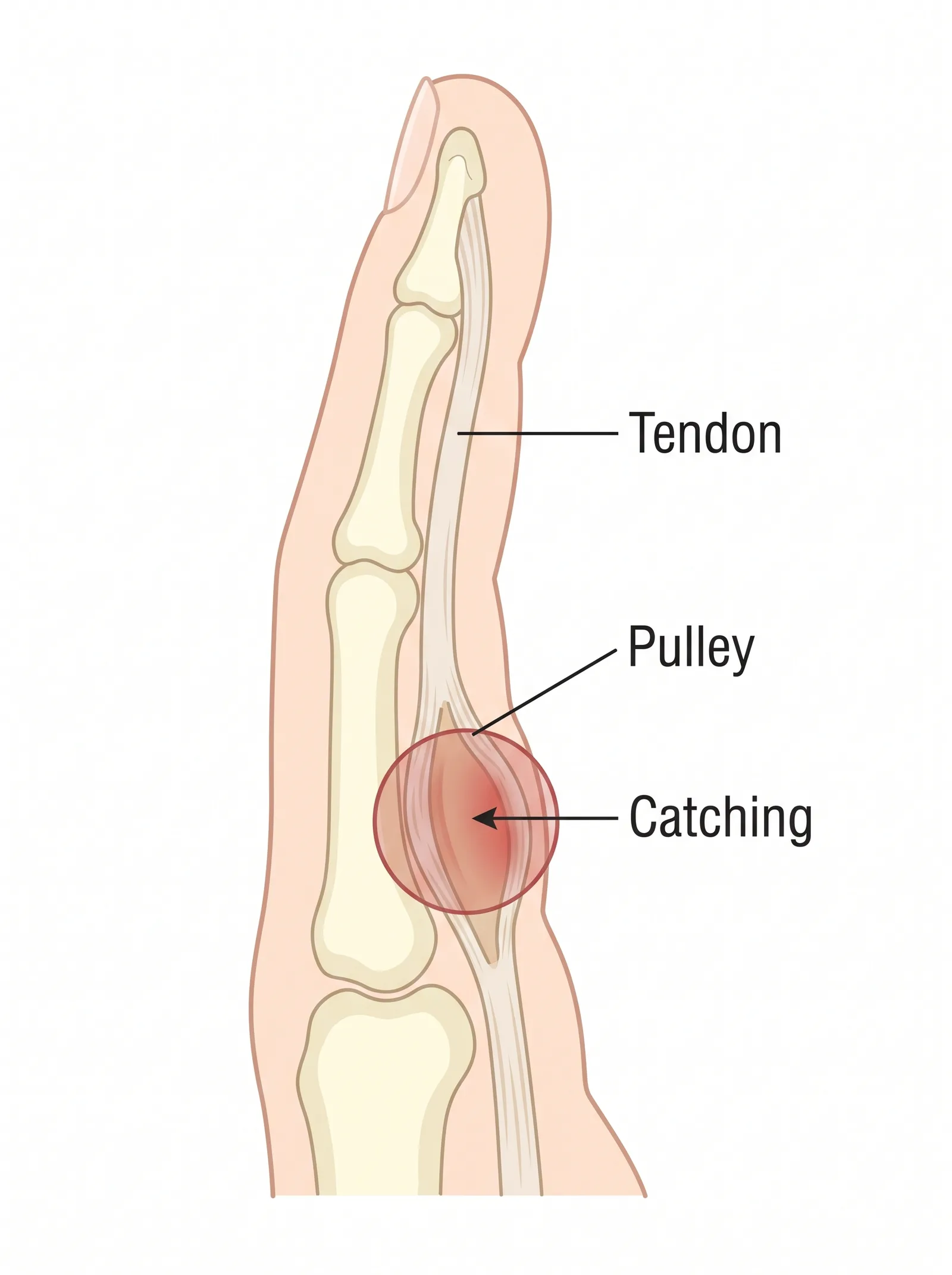
Its medical name is stenosing tenosynovitis, which means narrowing and swelling around a tendon. To understand it, picture how a finger bends. Tendons are strong cords that connect the forearm muscles to the finger bones. When a muscle tightens, the tendon slides and the finger bends. To keep the tendon close to the bone, the tendon runs through a series of snug loops called pulleys. Think of the pulleys like the small rings that hold the line on a fishing rod.
In trigger finger, the tendon or its lining swells, especially at the first pulley near the base of the finger in the palm. The swollen tendon no longer glides smoothly through the pulley. Instead it catches. When you force the finger to move, the swollen part pops through the pulley, which causes the sudden snap or click. In more advanced cases the finger locks in a bent position and has to be straightened with the other hand.
Any finger or the thumb can be affected. The ring finger and thumb are common. Trigger finger is more likely in people with diabetes, in those whose work or hobbies involve firm, repeated gripping, and in women more often than men. Often there is no single clear cause.
The condition is not dangerous, but it can be painful and can make daily tasks frustrating. The good news is that it responds well to treatment, and care always starts with the simplest steps. For a short overview, see our trigger finger service page, which links back to this fuller guide.
What are the symptoms of Trigger Finger, and when should you see a specialist?
The hallmark of trigger finger is catching or clicking when you move the finger.
Common symptoms include the following.
- A snapping or popping feeling when you bend or straighten the finger. - A tender bump in the palm at the base of the affected finger. - Stiffness, especially in the morning, that loosens as the day goes on. - A finger that locks in a bent position and pops straight, sometimes with pain. - In advanced cases, a finger stuck bent that must be straightened by hand.
Early on, symptoms may be worse in the morning and may ease with use. As the condition progresses, the catching happens more often and can become painful.
It is reasonable to see a specialist when the catching keeps happening, when there is pain at the base of the finger, or when the finger locks. If a finger becomes stuck and cannot be straightened even with gentle help, it is best to be seen sooner, because a finger held bent for a long time can become stiff. People with diabetes may notice trigger finger is more stubborn, and getting checked early is worthwhile.
How is Trigger Finger diagnosed, and what does the visit involve?
Trigger finger is usually diagnosed by talking and examining, without special tests.
Dr. Hunter will ask which finger is involved, when the catching happens, whether the finger locks, and how it affects your day. Your health history, including diabetes, is helpful to share.
The exam is straightforward and gentle. Dr. Hunter will watch you open and close the hand to see the catching, feel for the tender bump in the palm where the swollen tendon meets the pulley, and check how far the finger moves. Often the diagnosis is clear from this alone. You may be asked to make a fist and slowly straighten the fingers so the catch can be seen.
Imaging is rarely needed. X-rays or ultrasound are used only in unusual cases, for example if there is a concern about arthritis or another cause of the symptoms. The office will explain if any test is recommended and why.
What happens during trigger finger release, step by step?
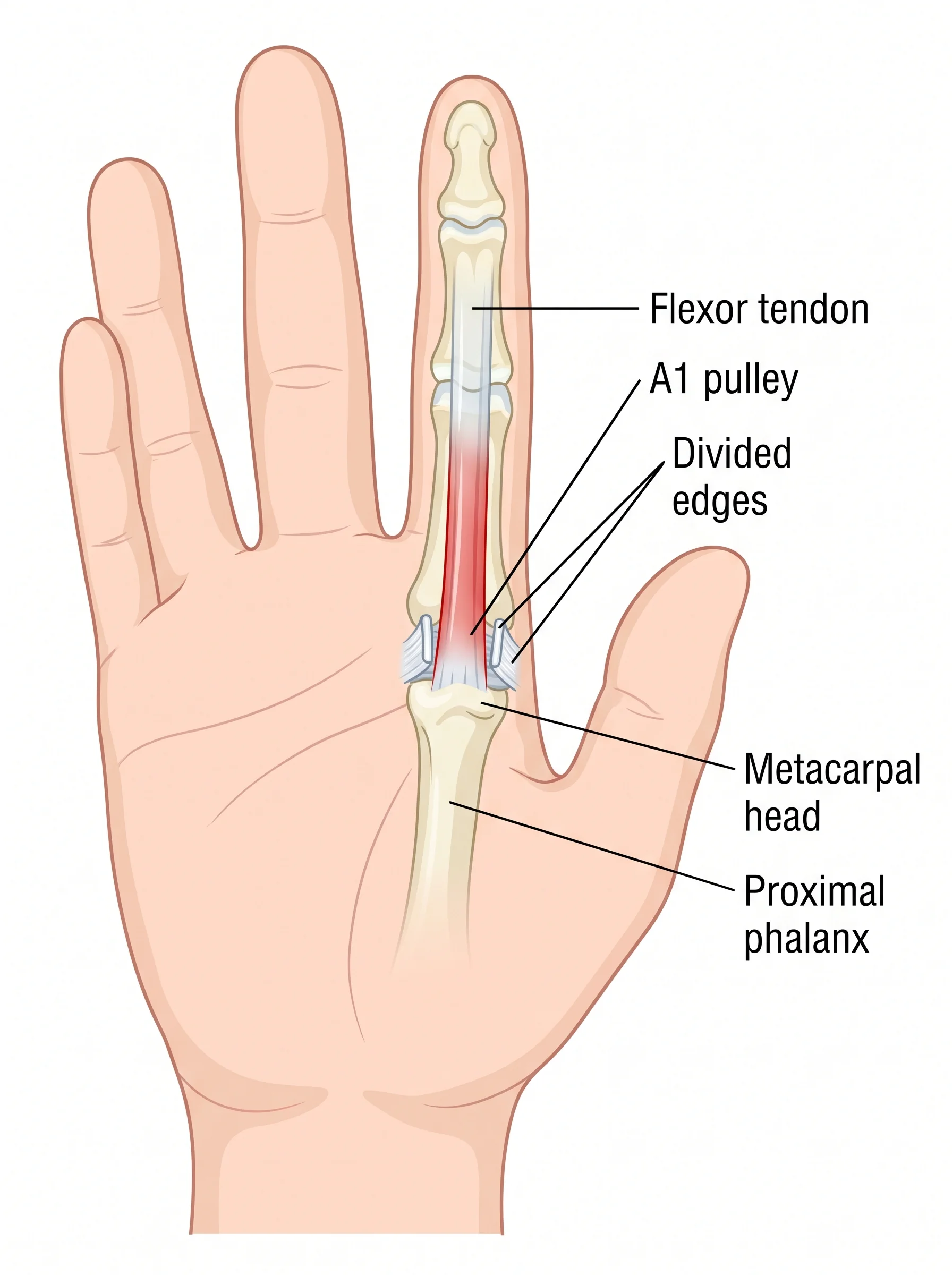
Trigger finger release is a short procedure that opens the tight first pulley so the tendon can glide freely again.
Here is the usual sequence.
Before the day. You and Dr. Hunter agree that a release is the right step, usually after injections or splinting have not solved the problem. The office reviews your medicines and health. Insurance questions are answered by the office.
Anesthesia. The procedure is almost always done with local anesthesia, which is numbing medicine placed in the palm. You stay awake. General anesthesia is not needed for a standard release.
The release. A small cut is made in the palm at the base of the finger. Dr. Hunter carefully opens the first pulley, the tight loop that the tendon was catching on. After the pulley is released, you may be asked to move the finger so the team can see that it now glides smoothly without catching. This is one advantage of staying awake.
Closing. The skin is closed with a stitch or two and a small dressing is applied. The procedure usually takes only a few minutes to about fifteen minutes. It is done as an outpatient, so you go home the same day.
Right after. You can usually move the finger right away. Because the hand is numb, arrange a ride home. The office reviews how to care for the small wound.
Some people are candidates for a needle release, in which the pulley is opened with a needle tip in the office rather than with an open cut. Dr. Hunter will tell you whether that option fits your finger.
What is the recovery timeline for Trigger Finger?
Recovery from trigger finger release is usually quick and is measured by what the finger can do.
The ranges below are typical. According to general guidance from the American Academy of Orthopaedic Surgeons, most people use the hand for light activity within days and regain full comfortable motion over a few weeks. These are ranges, not promises.
Day 1 to 3 (move early). You gently bend and straighten the finger right away. Moving early helps prevent stiffness. You keep the dressing clean and dry. The catching is usually gone immediately, which many people notice at once.
Week 1 to 2 (light use). Soreness in the palm settles. A stitch, if used, often comes out around 10 to 14 days. You use the hand for light daily tasks. The milestone is smooth motion without catching and less tenderness in the palm.
Week 2 to 4 (build grip). As the palm heals, you return to firmer gripping and more of your usual tasks. Some tenderness at the incision is normal and fades. The milestone is a comfortable grip.
Week 4 to 6 and beyond (full use). Most people are back to normal activity, including heavier gripping, by this point. Any lingering stiffness continues to improve with regular motion. The milestone is a finger that moves fully and comfortably.
Return to work depends on the job. Desk tasks often resume within a day or two. Jobs with heavy gripping may take a few weeks. The office will help you plan.
How should you prepare for the procedure?
Preparation for trigger finger release is simple.
Transportation. Arrange a ride home, since the hand will be numb and bandaged.
Home setup. Keep everyday items within easy reach. Loose sleeves and easy-on clothing help while the hand is bandaged.
Time off. Plan for light use of the hand for the first several days. Most people need little time away from desk work.
Who to have available. Having someone available on the first day to drive you and help with two-handed tasks is useful, though the recovery is usually light.
Health steps. Follow the office's guidance on medicines and blood thinners, and share a full list of what you take. If you have diabetes, keeping blood sugar in a good range supports healing.
Which warning signs should you call about?
Problems after trigger finger release are uncommon, but know what to watch for.
Call the office at during for any of these.
- Fever, spreading redness, warmth, or drainage at the wound, which can signal infection. - Pain that grows worse after the first few days instead of easing. - A finger that will not move or that becomes stiff and stuck. - New numbness or tingling in the finger. - A wound that keeps bleeding after gentle pressure.
If you have a severe or fast-changing problem and cannot reach the office, seek urgent or emergency care. Calling to ask is always reasonable.
What results can you expect from Trigger Finger?
Trigger finger release has a strong track record.
According to general guidance from the American Academy of Orthopaedic Surgeons, the procedure relieves catching and locking in the large majority of people, and it rarely comes back in the treated finger. Serious complications are uncommon. These are ranges, not promises.
It is also worth knowing that steroid injections alone resolve many cases without any procedure at all, which is why they are usually tried first. When a release is needed, the result is typically durable. If you have diabetes or several fingers involved, Dr. Hunter will talk with you about what to expect in your situation.
What are the treatment options?
- 01Rest and activity changesCutting back on firm, repeated gripping can let the swelling settle. Padding a tool handle or changing how you grip can reduce the load on the tendon.
- 02SplintingA small splint can hold the affected finger straight, often at night. This keeps the tendon from catching while it rests and can be enough to calm mild cases over several weeks.
- 03Anti-inflammatory medicineOver-the-counter medicine that lowers swelling may ease symptoms. Check with the office or your regular doctor to be sure it fits your health.
- 04Gentle stretchingA hand therapist can show you gentle motion and stretching to keep the finger moving and reduce stiffness.
- 05Steroid injectionA shot of corticosteroid, a medicine that lowers swelling, placed near the pulley is a common and effective step. It reduces the swelling so the tendon can glide again. Many people get lasting relief from one or two injections. Relief may be partial or temporary in some people, and injections may work less well in people with diabetes. The office will explain what to expect and how many injections are reasonable.
How do payments work?
Contact the office to confirm insurance participation.
Trained at Campbell Clinic (Orthopaedic Surgery Residency). Sees patients in Columbia.
About Dr. Hunter →