This guide goes past what de Quervain's is and into why it settles where it does: the compartment the two thumb tendons share, why a splint helps only when worn a certain way, why the same injection works for one person and not the next, and what the weeks after a release feel like.
Lee Hunter diagnoses and treats de quervain's tenosynovitis in Columbia, from the first visit through recovery.
What do patients ask most?
Can I get this in both wrists at the same time?+
How many steroid injections is too many?+
Is this related to carpal tunnel syndrome?+
Can it come back after surgery?+
Who treats de quervain's tenosynovitis: a complete guide in Columbia?
Lee Hunter is a board certified orthopedic surgeon who treats de quervain's tenosynovitis: a complete guide in Columbia, TN. Dr. Hunter sees patients at the practice in Columbia; appointments can be requested through this site.
Why does it hurt in one exact spot on the thumb side of my wrist?
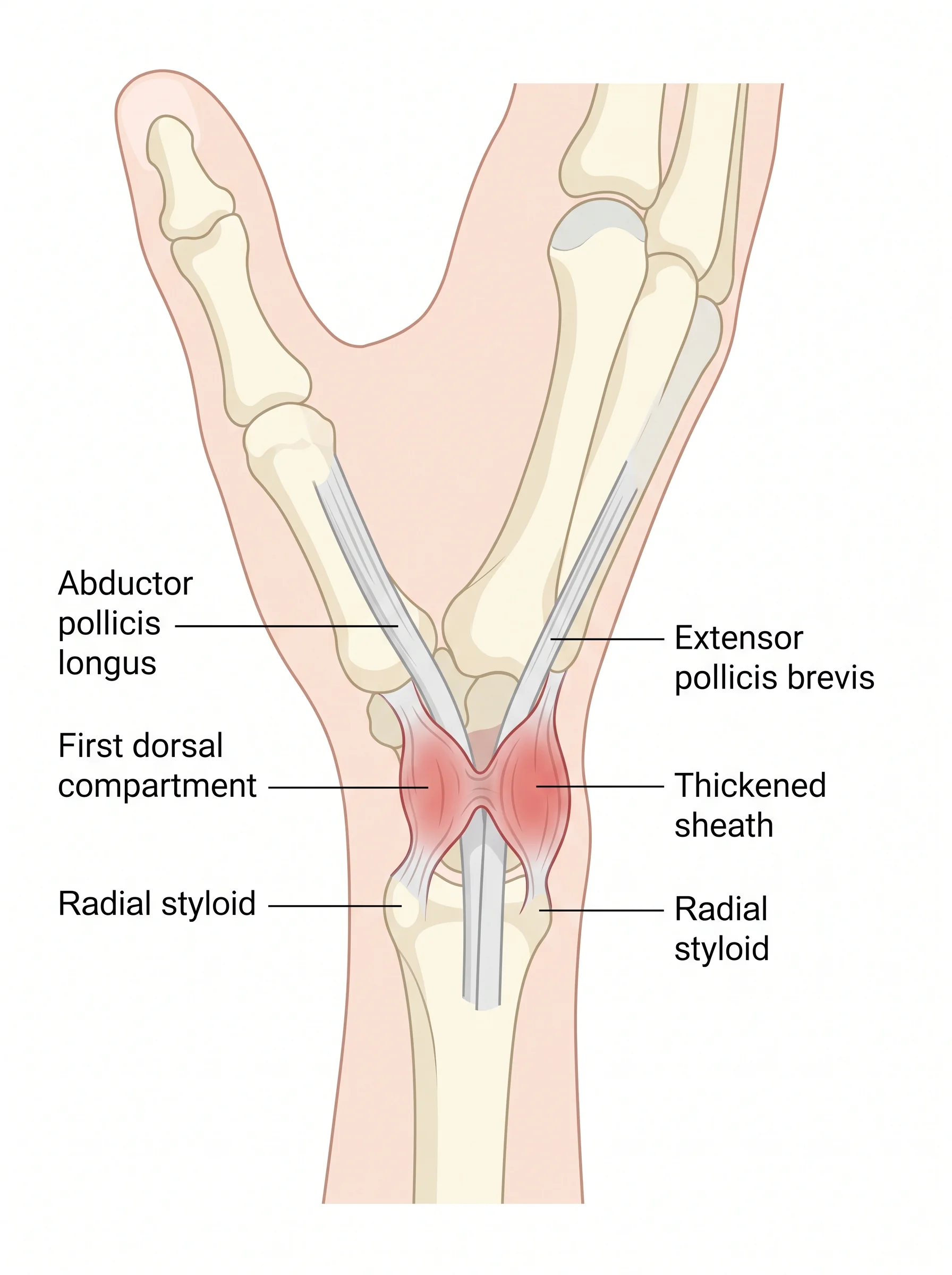
The back of the wrist is not one open space.
It is divided into six narrow tunnels, side by side, each carrying tendons out to the hand. Surgeons number them from the thumb side across. The first tunnel is the one that gives trouble, and its shape explains why.
That tunnel sits directly on top of the radial styloid, the bony point at the end of the forearm bone on the thumb side. The floor is a shallow groove in that bone. The roof is the extensor retinaculum, a tough strap that holds the tendons down so they do not lift away when you move. Between floor and roof, the two thumb tendons make a sharp turn around the corner of the bone, the way a rope turns around a pulley. Every thumb movement presses them into that corner. None of the other five tunnels asks its tendons to do quite this much.
What changes in De Quervain's is mostly the roof, not the tendon. The retinaculum thickens and the lining underneath stiffens, so the tunnel narrows from the outside in. Under a microscope the tissue looks more like scar than like a hot infection, even though the name ends in "itis". That is worth knowing, because it explains why resting a badly narrowed tunnel does not always fix it.
One more piece of anatomy decides a great deal. In many people a thin wall of tissue runs down the middle of the tunnel, splitting it into two separate lanes, one for each tendon. You cannot feel any of this from the outside, and it is the main reason two people with the same diagnosis respond differently to the same treatment.
Why did this start after my baby was born, or after I changed jobs?
Look at how a small baby gets picked up.
The hands go under the arms, the thumbs spread wide, the wrists tip down toward the little finger, and the whole weight of the child is lifted. That position, thumb out and wrist tipped away, is exactly the one that drags the first tunnel tendons around the bony corner. A parent repeats it dozens of times a day, often on no sleep, and often while carrying a car seat with the same grip.
Pregnancy and the months after add a second factor. Fluid shifts and soft tissue changes during pregnancy and while breastfeeding make tendon sheaths across the body more likely to swell and tighten. That is why carpal tunnel symptoms cluster in the same months. It is not caused by anything a parent did wrong.
The pattern is the same after any sudden change in how the hand is used. A new job with a scanner, a house move with weeks of boxes, a racket sport picked up in the spring, long stretches of holding a phone with the thumb spread. The common thread is not total workload. It is a new load, applied fast, before the tissue has had time to adapt.
Knowing your own trigger has a practical point. If the load that started it is still there every day, treatment aimed only at the sore tissue tends to hold for a while and then slip back.
What does the Finkelstein test actually show?
The test is worth understanding rather than just passing or failing.
The examiner takes hold of your thumb and pulls the wrist down toward the little finger. That drags both tendons through the narrowed tunnel and stretches them hard around the corner of the bone. If the tunnel is tight and irritated, this reproduces the pain, and it reproduces it in one place: over the tunnel, about an inch above the wrist crease on the thumb side.
There is a second version, where you tuck the thumb into your palm, close the fingers over it, and the wrist is tipped down. That one is properly called the Eichhoff test, and the mechanism is the same.
Here is what the test does not tell you. It does not measure how bad the problem is. It says nothing about whether the tunnel is divided into two lanes inside. And it is not perfectly specific, because tucking the thumb into the palm stretches other structures too.
So the location of the pain matters as much as the manoeuvre. Pain from thumb arthritis sits lower, at the saddle joint where the thumb meets the wrist, and is reproduced by pressing and grinding that joint rather than by stretching tendons. An unsettled wrist fracture and carpal tunnel syndrome each have their own pattern again. Two of these can sit side by side in the same wrist, which is common in older hands. A page cannot tell you which of these you have.
Why does a splint help, and how should I wear it?
A thumb spica splint is not a comfort measure.
It stops the tendons being dragged through a narrow tunnel while the tunnel calms down. It holds the wrist slightly back and the thumb out in a relaxed position, so the tendons sit at an easy length rather than a stretched one.
Two details decide whether it works. First, the splint has to include the thumb, usually leaving the tip free. A plain wrist brace from a pharmacy stops the wrist and leaves the thumb swinging, which misses the point. Second, consistency. A splint worn only for hard tasks gives the tissue no continuous stretch of quiet. Most people are asked to wear it through the day for a few weeks, and at night as well early on.
Wearing it does not mean the hand is out of use. The fingers stay free and should keep moving. What is being avoided is the loaded, thumb out, wrist down position: lifting a toddler under the arms, wringing a cloth, carrying a bag hooked over a spread thumb.
Give it a fair trial before judging it. Symptoms present for a few weeks often ease over a few weeks of splinting. Symptoms present for many months are less likely to settle on splinting alone, which is a reason to move up the ladder rather than keep waiting. Hand therapy adds tendon gliding, which keeps the tendons moving through the sheath without loading them,.
Why does the steroid injection work well for some people and not others?
An injection puts a small amount of steroid inside the tendon sheath.
The steroid quiets the thickened lining, the tunnel effectively gets roomier, and the tendons glide again. When it lands in the right place, relief usually begins within a few days to about two weeks. According to general guidance from the American Society for Surgery of the Hand, many people improve after one or two injections, and for some the symptoms return later.
The commonest reason it falls short is that thin dividing wall inside the tunnel. If your tunnel is split into two lanes and the needle fills only one, the tendon in the other lane is left exactly as it was. The pain then improves partly, or not at all, or returns quickly. This is not a technique failure and nobody can predict it by feel. Ultrasound can show a divided tunnel and guide a second injection into the lane that was missed.
Other things shift the odds. Symptoms present for a long time respond less well than recent ones. People with diabetes tend to get shorter relief, and should know that blood sugar can rise for a few days after any steroid injection.
The injection has real, if uncommon, downsides worth hearing first. The steroid can thin the fat under the skin at the site, leaving a small dip, and can lighten the skin color there. Those changes show more in darker skin and are often permanent, though they usually do not affect function. There is a small risk of infection, a possible flare of pain for a day or two, and a theoretical risk to the tendon itself, which is why injections are not repeated indefinitely.
What happens during a release, and what can go wrong?
A first dorsal compartment release is a short outpatient operation.
Numbing is usually local anesthetic, sometimes with sedation, and you go home the same day. Through a small incision over the tunnel, the roof is divided along its length so the tendons are no longer squeezed. Nothing is tightened or repaired. The tendons are inspected, and any extra slips or a dividing wall are found and released as well. That last step is the part that fixes what an injection could not reach.
The main risk is not the tendons. It is the superficial branch of the radial nerve, a small nerve that fans across exactly this part of the wrist on its way to the back of the thumb and index finger. It carries feeling only, not movement. Bruising or stretching it can leave numbness, or a patch of skin that is oversensitive, and a knock on it can feel like an electric shock. Most of this settles over weeks to a few months. In a small number of people a tender spot at the scar persists and needs desensitization work in therapy.
Two other problems are worth naming. An incomplete release, where a separate lane is not opened, leaves the original pain behind. And a release carried too far around toward the palm can let the tendons slip forward out of their groove, which feels like a snap. Both are uncommon, and both are why the operation is done through an incision that lets the surgeon see the anatomy rather than work blind.
What do the weeks of recovery actually feel like?
After a release, the hand is bandaged and the fingers move from the first day.
Light use, holding a cup, typing, dressing, is usually possible within a few days. Stitches commonly come out around ten to fourteen days. The area often feels numb or oddly sensitive for a while, and the scar can stay firm for a couple of months.
Grip and pinch lag behind comfort. Gripping something hard, wringing out a cloth, or lifting a child tends to feel weak and sore before it feels normal, and that commonly improves over six to eight weeks. Heavier manual work and sport often take longer. Scar massage and graded strengthening in hand therapy help, particularly if the hand was avoided for months beforehand.
Recovery after an injection looks different. There is no wound to protect, but the temptation to return straight to the activity that caused the trouble is strong, and that is the usual reason a good result does not last. It is reasonable to keep using the splint for harder tasks for a few weeks after an injection, and to bring the load back gradually. These are ranges, not promises.
How do I lift and work so it does not come straight back?
The single most useful change is how you pick things up.
Instead of spreading the thumb and hooking the load, scoop it. Slide the whole hand and forearm underneath, keep the thumb tucked alongside the fingers, and lift with the wrist straight. For a baby, that means hands under the bottom and behind the chest rather than under the arms.
The same principle covers most daily tasks. Carry shopping in the crook of the elbow or on the shoulder rather than hooked on a spread thumb. Open jars with a rubber grip pad rather than by clamping and twisting. Swap to tools with a fatter handle, because a thin handle forces a harder pinch.
Phones deserve their own mention. Long stretches of one handed scrolling hold the thumb spread and loaded, which is the same repetition that started the problem. Two thumbs, a stand, or voice input all reduce it.
Finally, know when to come back. Pain settling steadily on a splint is going the right way and can be reviewed in a few weeks. Pain that has not shifted at all after a fair trial, pain that wakes you, new numbness in the thumb or index finger, or a wrist that starts catching are all reasons to be seen again rather than wait it out. Pain in the same area that does not behave like a tendon problem may be coming from the joint underneath, and that is a different plan.
What are the treatment options?
- 01Change the load first, since the tendons cannot settle while the movement that irritates tChange the load first, since the tendons cannot settle while the movement that irritates them is repeated all day
- 02A thumb spica splint that rests thumb and wrist together, worn consistently rather than ocA thumb spica splint that rests thumb and wrist together, worn consistently rather than occasionally
- 03Ice over the tunnel, and a short course of anti-inflammatory medicine when that is safe foIce over the tunnel, and a short course of anti-inflammatory medicine when that is safe for you
- 04Hand therapy for tendon gliding, forearm strength, and a different lifting techniqueHand therapy for tendon gliding, forearm strength, and a different lifting technique
- 05A steroid injection into the tunnel, sometimes placed with ultrasound guidance when a firsA steroid injection into the tunnel, sometimes placed with ultrasound guidance when a first one falls short
- 06A second injection in selected cases, weighed against the tissue changes repeat injectionsA second injection in selected cases, weighed against the tissue changes repeat injections can cause
- 07First dorsal compartment release, which opens the roof of the tunnel, for pain that has noFirst dorsal compartment release, which opens the roof of the tunnel, for pain that has not settled with the steps above
How do payments work?
Contact the office to confirm insurance participation.
Trained at Campbell Clinic (Orthopaedic Surgery Residency). Sees patients in Columbia.
About Dr. Hunter →