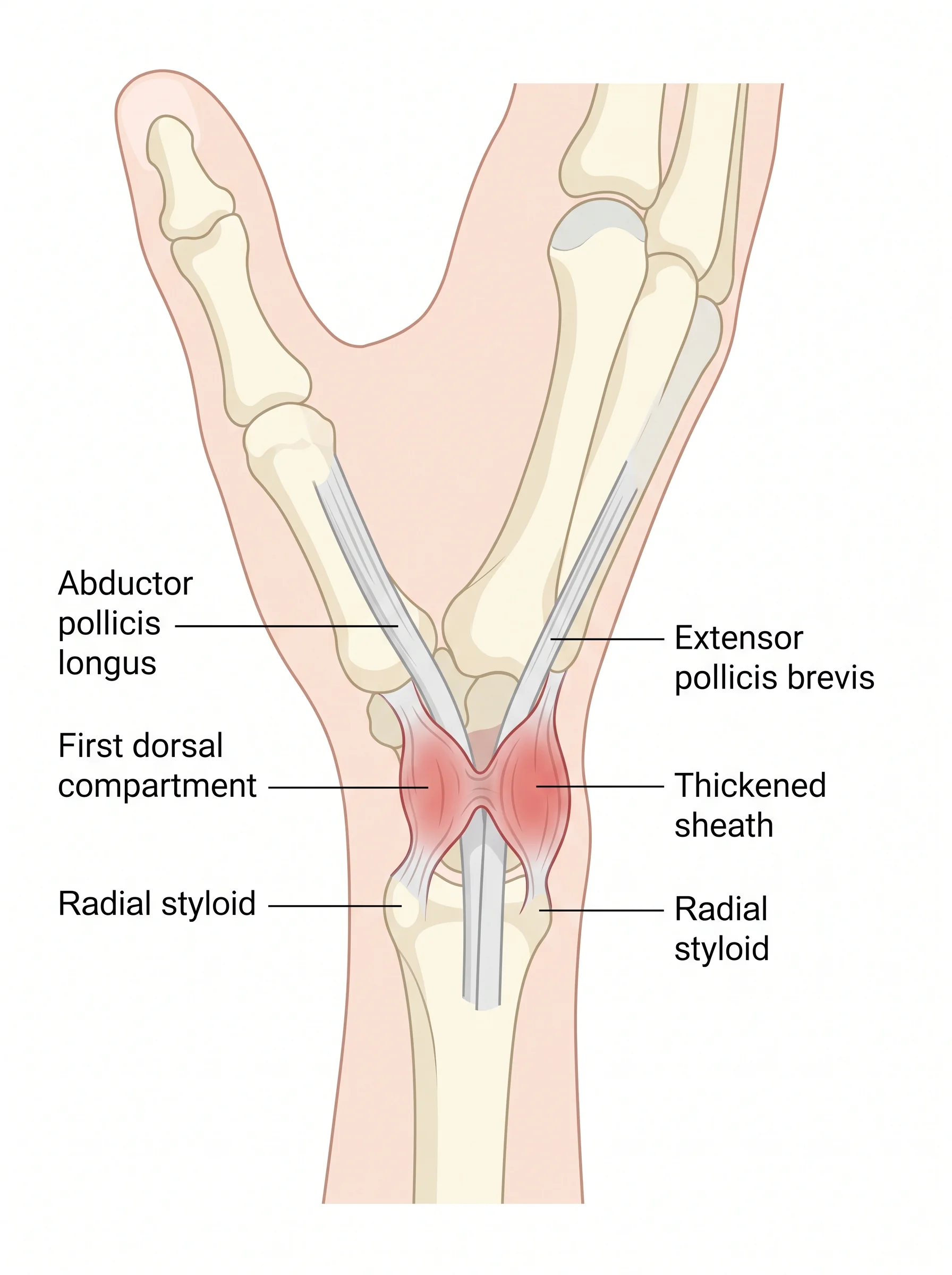
De Quervain's tenosynovitis is pain on the thumb side of the wrist, caused by swelling in the sheath around the two tendons that lift the thumb. It hurts most when you lift, grip, or twist. Dr. Hunter evaluates and treats De Quervain's tenosynovitis in Columbia, beginning with a splint and changes to how you use the hand.
Lee Hunter diagnoses and treats de quervain's tenosynovitis in Columbia, from the first visit through recovery.
What do patients ask most?
Will this go away on its own?+
Do I have to stop picking up my baby?+
Does the steroid injection fix it for good?+
Is surgery a big operation?+
Who treats de quervain's tenosynovitis in Columbia?
Lee Hunter is a board certified orthopedic surgeon who treats de quervain's tenosynovitis in Columbia, TN. Dr. Hunter sees patients at the practice in Columbia; appointments can be requested through this site.
What is De Quervain's tenosynovitis?
Two tendons move the thumb away from the hand: the abductor pollicis longus, which pulls it out to the side, and the extensor pollicis brevis, which straightens it.
Near the wrist they run side by side through a narrow tunnel called the first dorsal compartment, lined by a slippery sheath so they can glide. When that sheath thickens and swells, the tendons no longer slide freely, and the rubbing causes pain.
The pain sits on the thumb side of the wrist, about an inch above the crease. It is worse when you lift with the thumb pointed up, wring out a cloth, turn a key, or lift a child under the arms. The spot is often swollen and tender to press.
It shows up often in new parents, because lifting a baby loads these tendons in the very position that hurts, many times a day. It is also seen in and after pregnancy, after a change in work or hobby, and in rheumatoid arthritis. Often no cause is found. A page cannot tell you which of these you have. Arthritis at the thumb base and an unsettled wrist fracture hurt in the same place.
How is De Quervain's tenosynovitis diagnosed?
The story and the exam carry most of it.
In the Finkelstein test, the examiner holds the thumb and bends the wrist toward the little finger. In the Eichhoff test, you tuck the thumb into the palm, close the fingers over it, and the wrist is bent the same way. Sharp pain over the first dorsal compartment is a positive result. The two names are often used for each other.
Imaging is usually not needed. An X-ray is taken when arthritis at the thumb base or an old fracture is possible. Ultrasound can show a thickened sheath, and whether the extensor pollicis brevis sits in its own side tunnel, which can make an injection less likely to work.
What is recovery like?
With a splint and changes to activity, symptoms often ease over several weeks.
After a steroid injection, relief usually begins within a few days to two weeks. According to general guidance from the American Society for Surgery of the Hand, most people improve after one or two injections, and symptoms return later for some. After a release, the hand is used lightly within days, and comfortable full use commonly returns over six to eight weeks. These are ranges, not promises.
What are the treatment options?
- 01Rest from the motions that hurt, and a different way of liftingRest from the motions that hurt, and a different way of lifting
- 02A thumb spica splint, which holds thumb and wrist still while the sheath settlesA thumb spica splint, which holds thumb and wrist still while the sheath settles
- 03Ice, and a short course of anti-inflammatory medicine when that is safe for youIce, and a short course of anti-inflammatory medicine when that is safe for you
- 04Hand therapy for tendon gliding and lifting techniqueHand therapy for tendon gliding and lifting technique
- 05A steroid injection into the tendon sheath, repeated once in some casesA steroid injection into the tendon sheath, repeated once in some cases
- 06First dorsal compartment release, an operation that opens the roof of the tunnel, for painFirst dorsal compartment release, an operation that opens the roof of the tunnel, for pain that has not settled with the steps above
How do payments work?
Contact the office to confirm insurance participation.
Trained at Campbell Clinic (Orthopaedic Surgery Residency). Sees patients in Columbia.
About Dr. Hunter →